

If you've just received a CTCA report filled with abbreviations like CAD-RADS, Agatston, stenosis, and LAD, this guide translates that language into plain English. Understand what the scan found, what it means for your heart, and what to ask your doctor.
The short answer
A CT coronary angiogram (CTCA) report describes the plaque and narrowing in each heart artery and summarises it as a CAD-RADS score, from 0 (no plaque) to 5 (an artery that is completely blocked). Scores of 1–2 mean mild disease, usually managed with lifestyle changes and often a statin. A score of 3 or higher usually warrants review by a cardiologist. Letters after the number, such as P2 or HRP, describe how much plaque there is and whether it has high-risk features.
What the Scan Actually Does — and Why It Matters
How CTCA Works
A CTCA is a non-invasive scan producing detailed 3D images of the arteries supplying your heart muscle. It uses an iodine contrast dye injected into a vein, and often a tablet or injection to slow your heart rate for sharper images.
How It Differs From a Stress Test
A stress test shows whether blood flow is reduced. A CTCA shows the artery wall itself, including early plaque that is not yet narrowing the artery. Current guidelines recommend CTCA as a first test for many people with new chest pain, particularly those at low-to-moderate likelihood of a blockage. A stress test may suit others better, and your doctor will choose the test that fits your situation.
The Artery Map: Reading Your Report's Geography
Your report names the main coronary arteries and describes each in segments — proximal (near the start), mid, and distal (far end). Location matters: a narrowing near the start of the LAD affects far more heart muscle than the same narrowing in a small side branch.
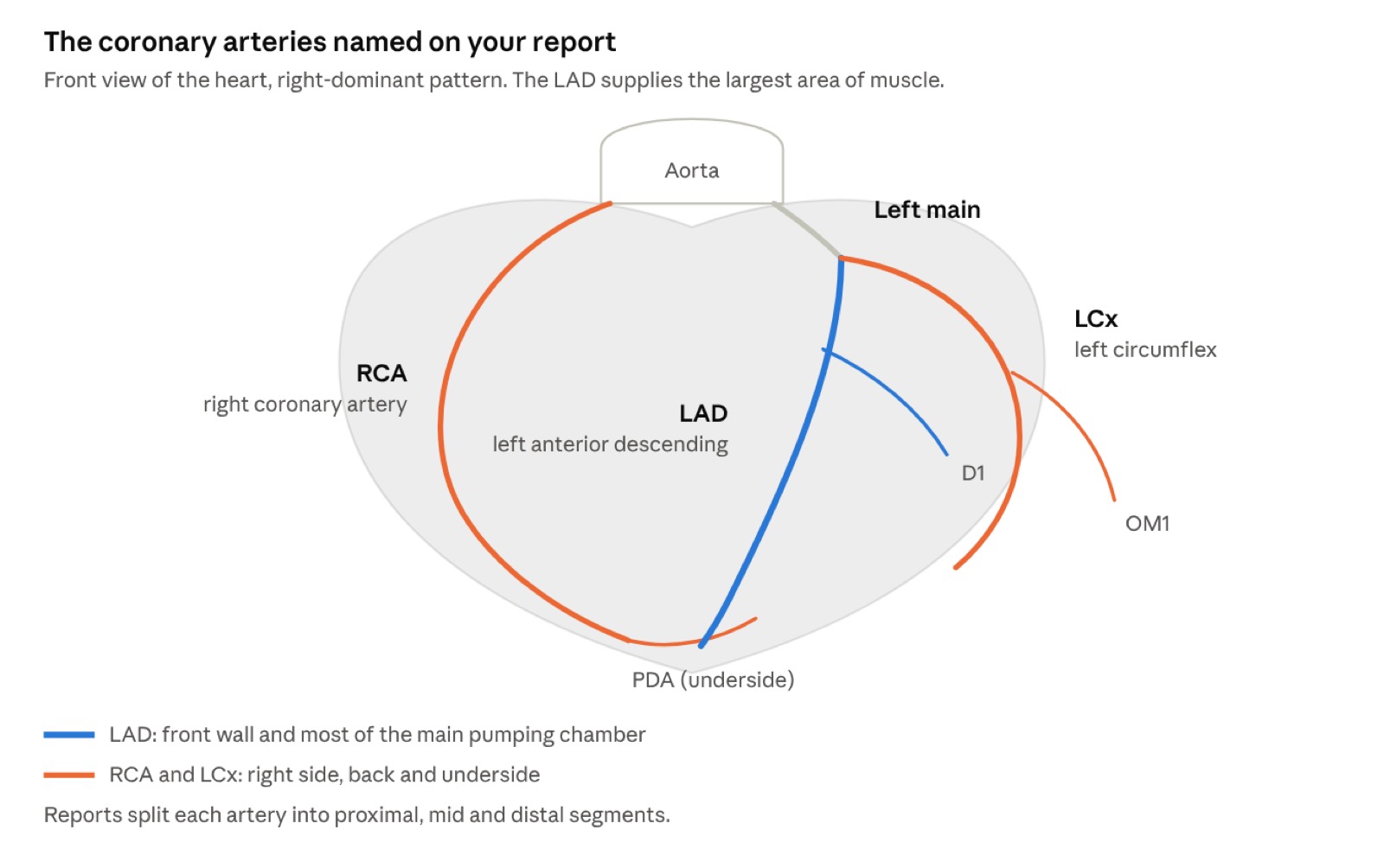
| Term | Full Name | What It Supplies |
|---|---|---|
| Left main (LM) | Left main coronary artery | Short trunk feeding both the LAD and LCx |
| LAD | Left anterior descending | Front wall of the heart and main pumping chamber |
| LCx | Left circumflex | Side and back of the heart |
| RCA | Right coronary artery | Right side and underside of the heart |
| PDA / PLV | Posterior descending / posterolateral | Underside of the heart |
"Right dominant" or "left dominant" describes which artery gives rise to the PDA — the branch supplying the underside of the heart. Most people are right dominant. Either pattern is a normal variation, not a disease.
Stenosis and CAD-RADS: Your Summary Score
Stenosis means narrowing of the artery channel by plaque. CAD-RADS (Coronary Artery Disease Reporting and Data System) condenses the whole scan into one standard category based on the worst narrowing found. The current version, CAD-RADS 2.0, was published in 2022.
CAD-RADS 0
No plaque. Very reassuring — chest pain is very unlikely to come from the coronary arteries.
CAD-RADS 1–2
1–49% narrowing. Early to mild atherosclerosis. Prevention with lifestyle and usually a statin.
CAD-RADS 3
50–69% narrowing. Moderate. Prevention, symptom treatment, and sometimes a blood-flow test.
CAD-RADS 4A–4B
Severe narrowing or left main ≥50%. Prompt cardiology review; invasive angiogram often considered.
CAD-RADS 5
100% blocked. Cardiology review; further tests may assess whether muscle beyond it is still alive.
The Letters After the Number: CAD-RADS Modifiers
CAD-RADS 2.0 reports often add modifier letters — for example CAD-RADS 3/P3/HRP. These are often as important as the number itself.
P1–P4
Plaque burden — how much plaque overall, from mild (P1) to extensive (P4). Guides how intensive prevention should be.
HRP
High-risk plaque — features linked to a higher chance of rupture. Prompts more intensive prevention.
I
Ischaemia — results of a blood-flow test such as FFR-CT, shown as positive, negative or borderline.
N
Non-diagnostic — part of the scan could not be assessed reliably, often due to heart motion, irregular rhythm, or heavy calcium.
The CAD-RADS category tracks closely with long-term outcomes. People with CAD-RADS 0 have an excellent outlook; risk rises progressively with higher categories and higher plaque burden.
The Calcium Score (Agatston Score)
Many CTCAs include a calcium score — a quick scan without dye that measures how much calcified (hardened) plaque is in your coronary arteries, reported as an Agatston number.
0 = very low risk
1–99 = mildly increased risk
100–399 = moderately increased risk (treatment considered)
400 or more = high risk (treatment usually recommended)
100–399 moderately increased risk (treatment considered); 400 or more high risk (treatment usually recommended). Your report's P grade uses slightly different cut-offs (P1 1–100, P2 101–300, P3 301–999, P4 above 1000).
Your report may also give a percentile — comparing you with people of the same age, sex and ethnicity. A high percentile means your arteries are ageing faster than expected.
Three Common Misunderstandings
Zero is reassuring, not a guarantee
In the CONFIRM registry, 3.5% of symptomatic patients with a zero calcium score still had ≥50% narrowing. The contrast CTCA still matters.
Calcium ≠ narrowing
A high score can sit alongside open arteries. Heavy calcium can also blur images and make narrowings harder to measure.
A rising score on a statin isn't bad
Statins stabilise plaque by making it more calcified. A higher score after starting treatment does not mean the medicine has failed.
Plaque Types: What Your Report Is Describing
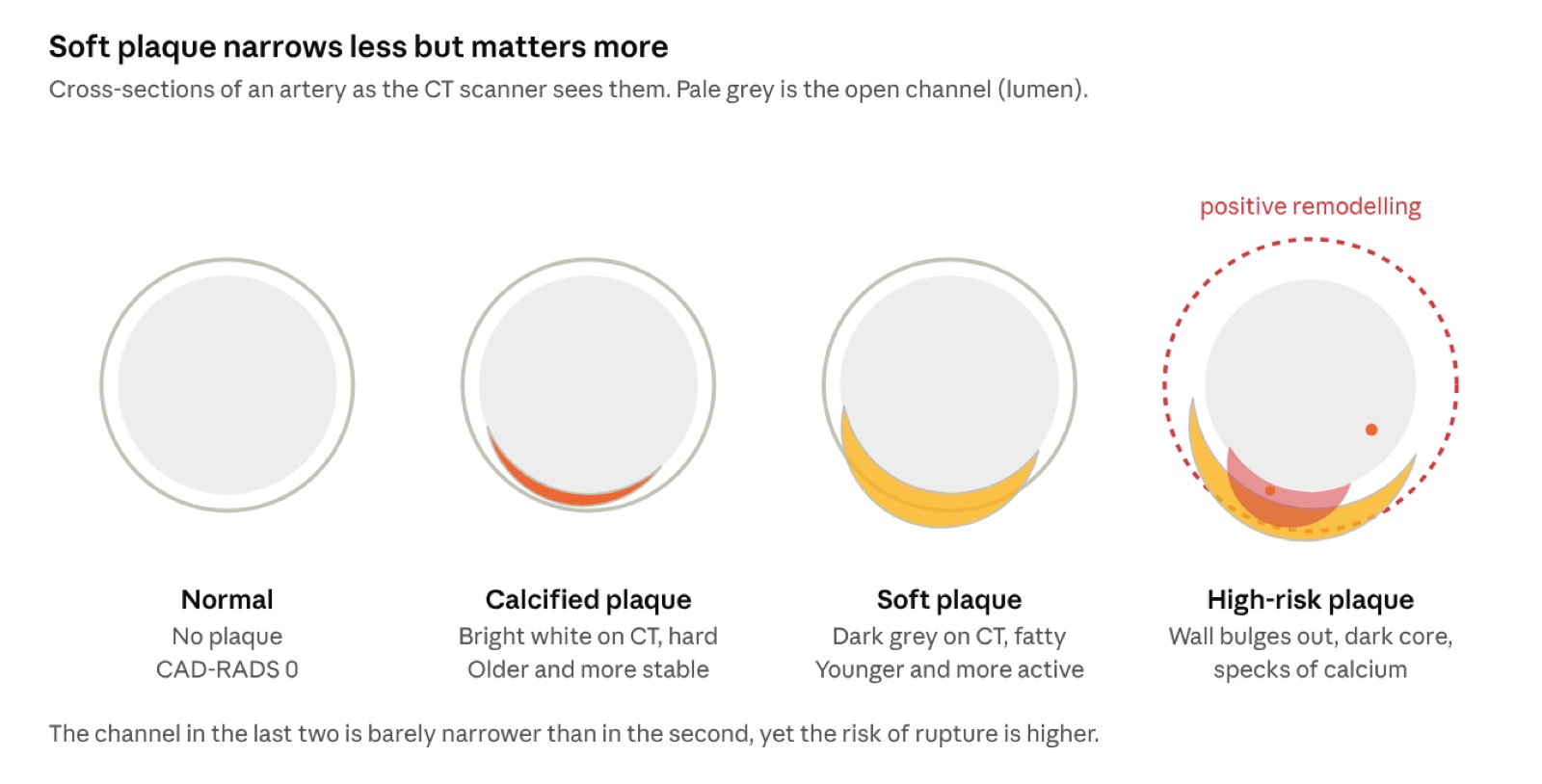
Calcified Plaque
Older, hardened build-up. Bright white on CT. Generally more stable and less likely to rupture suddenly.
Non-Calcified (Soft) Plaque
Younger, fattier build-up. Dark grey on CT. More active and more likely to cause trouble — even without significant narrowing.
High-Risk Plaque (HRP)
Labelled when a plaque shows ≥2 of: positive remodelling, low-attenuation core, spotty calcification, or napkin-ring sign. Prompts intensive prevention — not automatically a stent.
A Worked Example: One Report, Translated
Here is a typical CTCA conclusion, followed by what it means in plain English.
"Right dominant circulation. Agatston score 186 (78th percentile). Mixed plaque in the proximal LAD causing 50–69% stenosis, with positive remodelling and low-attenuation plaque. Mild non-obstructive plaque in the mid RCA. LCx unremarkable. Impression: CAD-RADS 3/P2/HRP."
| Report Says | Plain English |
|---|---|
| Right dominant circulation | A normal anatomical pattern |
| Agatston 186, 78th percentile | Moderate calcified plaque — more than most people of the same age and sex |
| Mixed plaque, proximal LAD, 50–69% | A moderate narrowing near the start of the most important artery |
| Positive remodelling, low-attenuation plaque | That plaque has high-risk features |
| CAD-RADS 3/P2/HRP | Moderate narrowing, moderate overall plaque, high-risk features present |
What Happens Next — and Questions to Ask
Management by CAD-RADS
CAD-RADS 0
Reassurance. No heart-specific medication needed; look for other causes of symptoms.
CAD-RADS 1–2
Prevention: statin scaled to plaque burden, blood pressure, diabetes, smoking, diet and exercise.
CAD-RADS 3
Prevention plus often low-dose aspirin; blood-flow test if symptomatic.
CAD-RADS 4–5
Cardiology review; invasive angiogram often recommended — urgently for left main or three-artery disease.
Medicare and cost
Medicare covers a CT coronary angiogram when a specialist requests it and you meet set clinical criteria. There may still be a gap fee. A GP-requested scan is not rebated. If extra analysis such as FFR-CT is offered, ask whether there is an additional fee.
7 Questions to Ask Your Doctor
- What is my CAD-RADS category, and what does my plaque burden (P grade) mean for me?
- Do I have any high-risk plaque features?
- Should I be on a statin, and what LDL level should I aim for?
- Do I need aspirin?
- Does any narrowing need a blood-flow test such as FFR-CT or a stress test?
- Were there any incidental findings needing follow-up?
- Should my family be checked, given what my scan showed?
For GPs
- Medicare: CTCA (MBS 57360) is rebated only when a specialist or consultant physician requests it, for stable or acute symptoms consistent with ischaemia at low-to-intermediate risk. A GP request is not rebated.
- Repeat scans: not rebated again within 5 years if a previous CTCA showed no obstructive disease, unless criteria for invasive angiography are met. Check for prior imaging before referring.
- Include in the referral: symptoms and relation to exertion, risk factors and family history, eGFR, heart rate and rhythm (AF or rate above 65 reduces image quality), asthma or beta-blocker/GTN contraindications, contrast allergy, and previous cardiac imaging.
- Acting on results: CAD-RADS 1–2: start or intensify lipid-lowering, scaled to plaque burden (P grade) or HRP. CAD-RADS 3: symptom management and consider functional testing. CAD-RADS 4A: cardiology review. 4B or 5: urgent cardiology review. (CAD-RADS 2.0)
- Non-obstructive plaque is disease: it warrants statin therapy with an LDL target rather than a "normal" label. (SCOT-HEART)
- Incidental findings: follow up lung and other findings flagged in the report.
General information for referring practitioners. Check current MBS and PBS criteria before acting.
Frequently asked questions
What does CAD-RADS 2 mean?
Mild narrowing (under 50%) caused by plaque. It doesn't limit blood flow, but it is real atherosclerosis. Treatment focuses on prevention, usually lifestyle changes and often a statin, rather than a procedure.
Do I need an invasive angiogram after my CTCA?
Usually only if the scan shows severe narrowing (CAD-RADS 4 or 5), significant left main disease, or symptoms that continue despite treatment. Moderate narrowing (CAD-RADS 3) is often assessed first with a test of blood flow.
What does "HRP" or high-risk plaque mean?
The plaque has features linked to a higher chance of rupture, even when it isn't narrowing the artery much. It usually prompts more intensive prevention.
How is a CTCA different from a stress test?
A stress test detects reduced blood flow, which usually appears only once an artery is already significantly narrowed. A CTCA looks directly at the artery wall and can find early plaque. Guidelines recommend it as a first test for many people with new chest pain; a stress test suits others better.
My CTCA showed no plaque. Is my chest pain from my heart?
A CAD-RADS 0 result makes it very unlikely the pain is coming from the coronary arteries. Other causes are worth discussing with your GP.
The Bottom Line
A CTCA is valuable because it can find coronary disease early — often years before a heart attack. Whatever your report says, the most powerful levers remain the familiar ones: not smoking, controlling blood pressure and cholesterol, staying active, eating well, and taking prescribed medicines consistently.
Don't Ignore Plaque
Non-obstructive plaque still causes heart attacks. "Nothing is blocked" does not mean nothing needs treating.
Don't Stop Your Statin
A rising calcium score on a statin often means the plaque is stabilising — not that the medicine has failed.
Don't Ignore New Symptoms
A normal scan does not override new or changing symptoms. See your doctor again if anything changes.
Bring your report to your GP or cardiologist and ask them to walk you through your CAD-RADS category, calcium score, plaque findings, and what they recommend for you. Key references include CAD-RADS 2.0 (2022), the SCOT-HEART trial, and the ISCHEMIA trial.